


Beyond the Fossil Fuel Phase-Out: GAGGA’s Call for a Feminist, Locally-Led Just Transition After Santa Marta
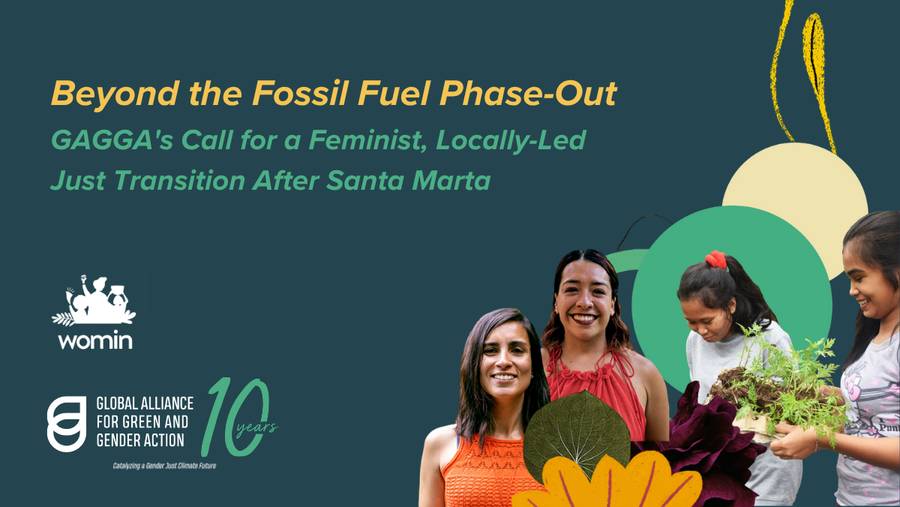
A reflection from GAGGA on the First Conference on Transitioning Away from Fossil Fuels in Santa Marta — and what must come next.
For five days, the coastal city of Santa Marta, Colombia held the world’s attention. From 24 April to 29 April 2026, governments, multilateral organisations, and civil society gathered for the First Conference on Transitioning Away from Fossil Fuels — a landmark moment convened in the wake of COP30, to move from political commitment to concrete action on the fossil fuel phase-out.
For all its limitations and contradictions, the conference in Santa Marta marked an important political milestone: the first time governments, civil society, Indigenous leaders, feminist movements, and multilateral institutions gathered explicitly around the question of how to move beyond fossil fuels. That matters. For decades, fossil fuel phase-out was treated as politically impossible in international climate negotiations. The fact that the global conversation has shifted from whether a phase-out should happen to how it must happen reflects years of pressure from frontline communities and climate justice movements worldwide. Santa Marta created political space that did not exist before — and that space must now be defended, expanded, and made accountable to those most affected by the transition.
Alongside the official negotiations, the People’s Summit for a Fossil-Free Future demonstrated the scale and strength of global civil society mobilisation behind a just transition. Coordinated by a coalition of more than 900 organisations and networks — including El Consejo Permanente para la Transición Energética Justa, the Global Campaign to Demand Climate Justice (DCJ), and Climate Action Network International (CAN) — the summit created an independent movement space led by frontline organisations, Indigenous Peoples, Afro-descendant communities, feminist movements, youth, and workers. Ahead of the high-level segment, these movements launched the People’s Declaration for a Rapid, Equitable, and Just Transition for a Fossil-Free Future, outlining 15 principles for a just transition and calling for an equitable fossil fuel phase-out aligned with limiting warming to 1.5°C, universal access to renewable energy, and a transition rooted in justice, reparations, and community self-determination. The declaration underscored a central message echoed throughout Santa Marta: the transition away from fossil fuels cannot simply replace one extractive system with another.
At the same time, conference participants and organisations including the Fossil Fuel Treaty Initiative stressed that a binding international framework for phasing out fossil fuels is still missing. A follow-up conference is planned for 2027, to be convened by the Pacific island state of Tuvalu together with Ireland, as part of ongoing efforts to complement the UN climate negotiations and respond to the slow pace of global agreements on fossil fuel phase-out.
The delegations have gone home. The question that hung over every negotiation, every side event, every corridor conversation in Santa Marta is now back where it has always lived: in the hands of the communities — and in particular women, Indigenous peoples, and frontline organisations in the Global South — who will bear the cost of whatever comes next.
The fossil fuel phase-out is inevitable. The form it takes is not. This is the distinction that matters — and the one that GAGGA, together with WoMin African Alliance, has been insisting upon in our joint policy brief, From Fossil Fuels to Gender-Just Futures: Land, Care and Livelihoods as Foundations of a Just Transition, published ahead of the conference.
The danger hiding inside “green”
The global consensus on phasing out fossil fuels is real and necessary. But consensus can obscure as much as it reveals.
As delegates gathered in Santa Marta, a parallel reality was unfolding across the world: lithium, cobalt, copper, and rare earth minerals — the raw materials required to build wind turbines and electric vehicles — are being extracted from Indigenous and communal lands in the Global South, with little or no consultation, inadequate compensation, and no binding safeguards.
This is exemplified by cases documented and accompanied by GAGGA partner WoMin.
In South Africa’s Namaqualand, at least 700,000 hectares of Indigenous communal land has been earmarked for a green hydrogen megaproject designed primarily to export energy to Northwest Europe, not to address South Africa’s own energy crisis, where an estimated 600 million people across the continent still lack access to modern energy. The Strategic Environmental Assessment for this project excluded the directly affected Indigenous communities entirely.
In Uganda’s Busoga subregion, a rare earths mining licence covering approximately 300 square kilometres was granted in a region where communities depend on land for farming, water access, and everyday livelihoods, with women specifically excluded from consultation and decision-making processes.
This is what our policy brief names green extractivism. Delegations in Santa Marta were right to celebrate the political momentum toward fossil fuel phase-out. They also had a responsibility to name this contradiction plainly and to demand that what replaces fossil fuels is built on justice, not dispossession.
Climate finance is failing the people doing the most
The gap between what is promised and what is delivered runs through every part of this transition, but it is most acute in how climate finance flows, and who it reaches.
In 2023, 67% of the global energy supply still came from fossil fuels. African external debt has more than doubled since 2010, partly as a result of the very development finance instruments designed to enable a “just” transition. Planned fossil fuel production in 2030 would far exceed what is compatible with the 1.5°C goal. Recent scientific findings on the Amazon rainforest underscore that the 1.5°C target was never intended as a political aspiration to negotiate around; it was a physical limit beyond which ecosystems risk irreversible collapse. Yet too much climate finance architecture still behaves as though there is infinite time to deliberate, pilot, and delay.
Something is profoundly broken in how we fund climate action.
Women-led, community-based organisations are doing some of the most effective climate work on the planet. They are restoring ecosystems, governing land democratically, building food sovereignty, and pioneering locally-grounded renewable energy. Yet they are systematically locked out of climate finance by rigid legal registration requirements, reporting systems designed for large institutions, a bias toward loans over grants, and language barriers that consistently advantage Global North actors.
Climate finance under the Paris Agreement must be not only adequate and ambitious, it must be appropriate and accessible. That means grants, not loans. Direct access, not bureaucratic intermediaries. Feminist funds, women’s funds, and socio-environmental funds that already know how to channel resources to the frontline.
And it means something bolder still: climate reparations must be on the table. The communities most harmed by decades of fossil fuel extraction are owed more than new debt to fund their own adaptation.
The alternatives are not theoretical. They exist.
Amid the negotiations, it is easy to lose sight of something essential: the alternatives to extractive development are not theoretical. They exist. They work. And they are being built right now, by women, Indigenous communities, and frontline organisations around the world, as exemplified by GAGGA partners all over the wolrd.
In Paraguay, CONAMURI’s feminist agroecology schools train women across ten Indigenous communities in food sovereignty, native seed governance, and ecological stewardship. Their Semilla Róga, House of Seeds, protects and exchanges native seeds as a living commons.
In Zambia, Women Environs Zambia has engaged 600 rural women farmers in Indigenous seed multiplication across eight districts, providing affordable alternatives to costly commercial seeds and building community food resilience from the ground up.
In Nigeria’s Niger Delta, devastated by decades of oil extraction, the League of Queens International Empowerment has planted over 2,000 trees, built women-led climate action groups, and engaged government ministries on gender-responsive climate policy.
These are post-extractive pathways. They integrate food sovereignty, ecosystem restoration, community land governance and gender justice. What they need is not more study. They need funding. Political recognition. And a just transition framework that centres them — not as beneficiaries, but as leaders.
What GAGGA is holding decision-makers to
The conference in Santa Marta is over. GAGGA will be watching what comes out of it — and holding it to the standard that GAGGA partners across 60 countries deserve.
Policy-makers, decision-makers and funding partners must:
Scale and transform climate finance: reframe it as reparation, not charity. Meet existing targets and ensure climate finance reaches those who have borne the costs of extraction.
Ensure direct access for women-led community-based organisations: grants, not loans; flexibility, not bureaucracy; no new debt burdens.
Ensure women’s decision-making power: not participation as a checkbox, but genuine leadership in governance structures, including emerging mechanisms like the Belém Action Mechanism.
Put feminist post-extractive pathways at the centre: governance of commons, agroecology, community-owned energy must be recognised and resourced as the real alternatives they are.
End false solutions: no fossil gas as a “transition fuel,” no large-scale carbon offset projects that displace communities, no green extractivism without binding safeguards. No exceptions.
History is made in what follows
History is not made by declarations. It is made by what follows them.
COP30 agreed to transition away from fossil fuels. Countries continue to approve new oil, gas, and coal projects. Investment in upstream oil and gas has risen, not fallen. The gap between commitment and action is where frontline communities — and in particular women, Indigenous peoples, and those in the Global South — continue to pay the price.
A feminist, locally-led, commons-based just transition is not inevitable. It must be fought for: in every conference room, every policy process, and every funding decision.
The fossil fuel phase-out is coming. The question is whether it will reproduce the extractive logic that caused the crisis — or finally break from it.
GAGGA’s answer, drawn from a decade of frontline experience, is unambiguous: the difference lies in who controls resources, whose knowledge counts, and who leads.
Read the full GAGGA and WoMin African Alliance policy brief, From Fossil Fuels to Gender-Just Futures: Land, Care and Livelihoods as Foundations of a Just Transition.
#10yearsofGAGGA #MultiplyClimateAction #JustTransition #FundForward #GAGGA #GenderJustFutures